
Trail Of The Caribou
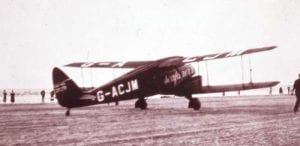 On August 8, 1934, an event of national and historical significance took place at Wasaga Beach. The first successful overseas flight from Canada took off from Wasaga’s naturally long, straight beach. The beach served as the perfect runway for such an endeavor!
The momentous event had its roots in an unsuccessful attempt that had been made the year before.
In 1933, British air ace Captain James Mollison and his wife, Amy Johnson, came to Wasaga Beach with their plane, called Seafarer II. Their hope was to break the world’s long distance flying record of 5,657.6 miles, which had been set by two French pilots in 1933. They planned to fly to Baghdad, a distance of about 6,300 miles.
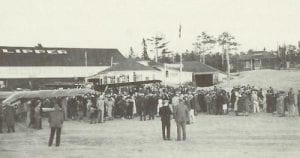 The presence of the Mollison’s and their plane, along with several experts from the De Havilland Aircraft Company, caused great excitement in Wasaga Beach! When the day of the great attempt dawned, almost everyone in town turned out to view the event. Children were sweeping the beach of sticks and stones to prepare for the spectacle.
The crowd was doomed to disappointment. There was a heavy crosswind blowing which foiled two attempts to get the plane into the air. On the third attempt, the plane became airborne but then touched down again, buckling its undercarriage and crippling the plane. No one was hurt, but the mishap ended any attempt at flight that summer.
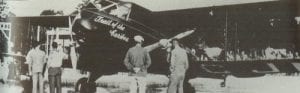 The next year, Wasaga residents heard that two Canadians, James Ayling and Leonard Reid, had bought the Mollison’s plane and intended to attempt the same flight that August. They had renamed the plane Trail of the Caribou.
In his brief book on the historic flight, G. Ray Gibson quotes one-time cottage owner Bill White’s eye-witness account of what took place that day:
“The Beach was quiet in those days…the most exciting event that would take place from time to time would be an aircraft from Camp Borden. This called for stopping whatever it was you might be doing to rush outside and watch the plane fly past.
“It was therefore with great excitement that we learned …. We were actually going to see an aircraft fly from the beach!”
The preparations for the flight proceeded in a somewhat similar manner to that of the Seafarer II. The De Havilland engineers were on hand to make the final adjustments to the craft. The Collingwood Board of Trade, in co-operation with the residents of the beach area, arranged to level the sand on the beach which was accomplished by using a road grader pulled by four large horses. Some four miles of the beach were leveled and all the large stones and wood were removed to allow for more success.
After much build-up and anticipation August 8 arrived and the take-off run was scheduled to begin at 0612. Similar to the Mollison’s setbacks the year before, strong crosswinds prevailed and the take-off was precarious to say the least. The plane ran for about a mile before it slowly rose into the air and after a wide sweep across Georgian Bay to gain altitude, it flew back over the people on the beach as it headed east to Baghdad.
White is quoted:
“We watched it fly into the distance until it was completely out of site. Next came the long wait until word came back on the radio on August 9th that the ‘Trail of the Caribou’ had landed in Heston, Middlesex, England. It had been in the air 30 hours 55 minutes. As kids, we were a little bit disappointed that the flight had not continued to Baghdad as that seemed more romantic than a place we had never heard of called Heston. As I now reminisce about the flight, I must admit that it was as thrilling to the people of Wasaga Beach that August 8, 1934, as any space flight is to today’s television viewers!”
Gibson also includes his own fascinating reconstruction of events on the day of the flight (this information was taken from his flight log):
“Ayling and Reid were up quite early on the morning of the flight to supervise the final inspection and loading of the aircraft. In addition to the standard 60-gallon fuel tanks on the plane, an additional 600-gallon tank was installed on the fuselage at the center of gravity of the aircraft. The engineers from De Havilland made their checkups and the ‘Trail of the Caribou’ was ready to fly.
“The crew said their final farewells and waved to a number of sightseers waiting for the flight. Take-off was at 0612, Canadian Standard Time, at a point approximately one mile from the start of roll. Soon, the engines were running and after a short heat-up period, the aircraft started to roll; very slowly at first, then getting faster as it sped down the beach. It seemed a lifetime before the tail lifted and another before the plane slowly lifted off the ground. There was a breeze blowing across the beach, which the crew corrected for as they slowly turned towards the lake.
“The aircraft slowly gained height and flew back over the point of departure as it headed east towards Peterborough. Its course brought it east along the St. Lawrence and was sighted by many people en route, particularly around the Quebec City area. It was last sighted as it flew over Bell Isle Strait at 1625 hours (4:25 p.m.) – they flew into darkness. The pilots had planned to captain the craft at 3-hour intervals. After the first two intervals, they reduced the cycle to 2-hour shifts. It was found that 3 hours was much too demanding and strenuous.
“From the start, they experienced trouble setting the engine throttles to run the aircraft at economical cruising speed. Although, once set, the engines ran with no difficulty. On the first leg of the journey, they had the benefit of a tail wind. On the eastern part of the Atlantic, they ran into a heavy fog bank, which forced them to fly blind for some 8 hours, before they sighted the Atlantic through breaks in the fog. While climbing out of the fog banks, they experienced carburetor icing on both engines. This caused the engines to operate with throttles frozen open, thus increasing fuel consumption from some 10 gallons per hour to 17-18 gallons per hour.
“Ayling and Reid were very much aware that their fuel supply was rapidly diminishing. They recognized that the record could not be made and decided to settle for being the first airmen to fly non-stop from Canada to Britain.
At 0615 hours E.D.S.T., on August 9, 1934, some 24 hours after leaving Wasaga Beach, they sighted Ireland. Although held back by head winds and far behind their estimated arrival time, they were particularly pleased to note that they were almost exactly on the course they had plotted for the flight. No doubt an excellent achievement, considering they were forced to fly the aircraft blind for a major portion of the trip across the Atlantic.
They arrived over England with 200 gallons of fuel on board and decided to land at Heston Airport, 30 hours 55 minutes after taking off from Wasaga Beach. The flight had been unsuccessful in its record-breaking attempt for the world’s longest non-stop distance in an aircraft; however, it was successful in establishing the first flight between Canada and Britain.
As pilots who had not made any previous long distance record attempts, they showed a high standard of professionalism. Their airmanship was second to none and their navigation superb. The flight proved to be the prototype for many flights that followed with the Air Bridge to Europe in the Second World War.
For some years after that historic flight, it wasn’t uncommon for small planes to take advantage of the long, natural runway offered by Wasaga’s beach. Although, as motor traffic on the beach increased, such casual escapades became increasingly hazardous and were eventually discontinued. Today, small planes are not an uncommon sight at Wasaga Beach, but they are all of the seaplane variety, landing on the water itself with the aid of pontoons.
On August 28, 1958, a stone cairn commemorating the historic flight was unveiled with due ceremony at the entrance to Nancy Island Historic Site. Ken Main, Assistant Controller of Civil Aviation in the Canadian Department of Transport was present for the unveiling.
In 1984, the Town of Wasaga Beach published Gibson’s 47-page account of the flight in a slim book, titled Trail of the Caribou.